Per Seat, Per Contact or Per Credit: How Lead-Gen Tools Bill
Four lead-generation tools, four different meters. This note explains what Apollo, Manychat, Brevo and Close actually charge for, what triggers overage, and where seat minimums and export caps hide, using the vendors' own pricing pages as of October 2026.
This article is a documentation review: it is based on the vendors' own published pages, checked on the date shown. We may earn a commission from some links; it never affects what we recommend.

Four lead-generation tools, four different meters. Apollo charges for seats and then for credits. Manychat counts Active Contacts. Brevo meters emails sent. Close bills per user and passes calling through at cost. The sticker price tells you almost nothing until you know which meter is running. This note explains each billing unit, what triggers overage, and where minimums hide, using the vendors' own pricing pages and help centers as read on October 9, 2026. Manychat's public pricing page blocked automated reading, so its figures come from the Manychat help center instead. Where a vendor publishes no number, this note says so rather than guessing.
Know the four meters before you compare sticker prices
Per seat means every human login costs money, whether that person sends one email or a thousand. Close and Apollo both start here. The risk is paying for dormant logins, so count the people who will actually work the pipeline.
Per contact means the size of your engaged audience sets the bill. Manychat uses this model. The risk is growth itself: a viral post can push you over the limit in a day.
Per volume means you pay for what goes out the door, usually emails. Brevo meters emails sent per month. The risk is a busy month costing more than a quiet one, with no change in headcount.
Per credit means actions consume a pooled currency. Apollo's email and phone reveals, and Close's AI features, work this way. The risk is opacity: a credit buys different things in different tools.
Read Apollo's seat price as the floor, not the bill
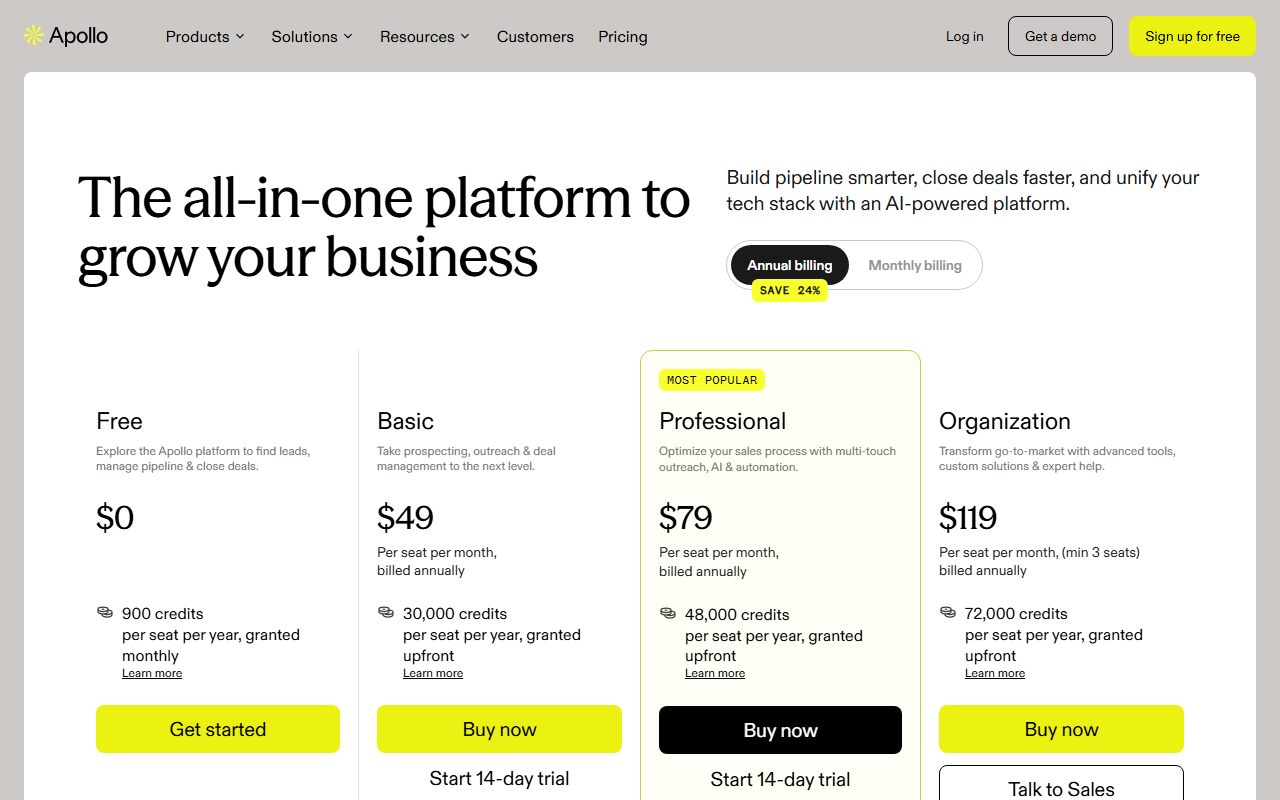
Apollo bills per user, then layers credits on top. Per the Apollo pricing page checked October 9, 2026, all seats on an account share one plan level, and credits are pooled across the team and granted at the start of each billing cycle.
Credits cover emails, phone numbers, email warmup, domains and mailboxes, and AI-researched data. Unused credits expire at the end of the cycle and do not roll over. That applies to plan-included and purchased add-on credits alike.
Add-on credits are bought with a slider under Customize Credits. They are charged immediately and renew every cycle until removed. A team that buys a one-time top-up and forgets it will keep paying for it.
Export has its own ceiling. Without a record selection limit, you can select and export up to 10,000 leads in one click. Lower plans impose a limit and higher plans loosen or remove it; Apollo does not publish per-plan figures.
Even 'unlimited' has fine print. The page defines an email credit cap for paying customers at the lesser of the dollars paid for the term divided by $0.025, or 1 million email credits per account per year, unless the order form says otherwise.
One gap to flag: the page as read on October 9, 2026 showed plan names (Free, Basic, Professional, Custom) but no per-seat dollar figures. Those sit in the in-app plan screen, so confirm them before budgeting.
Count Manychat's Active Contacts, not your followers
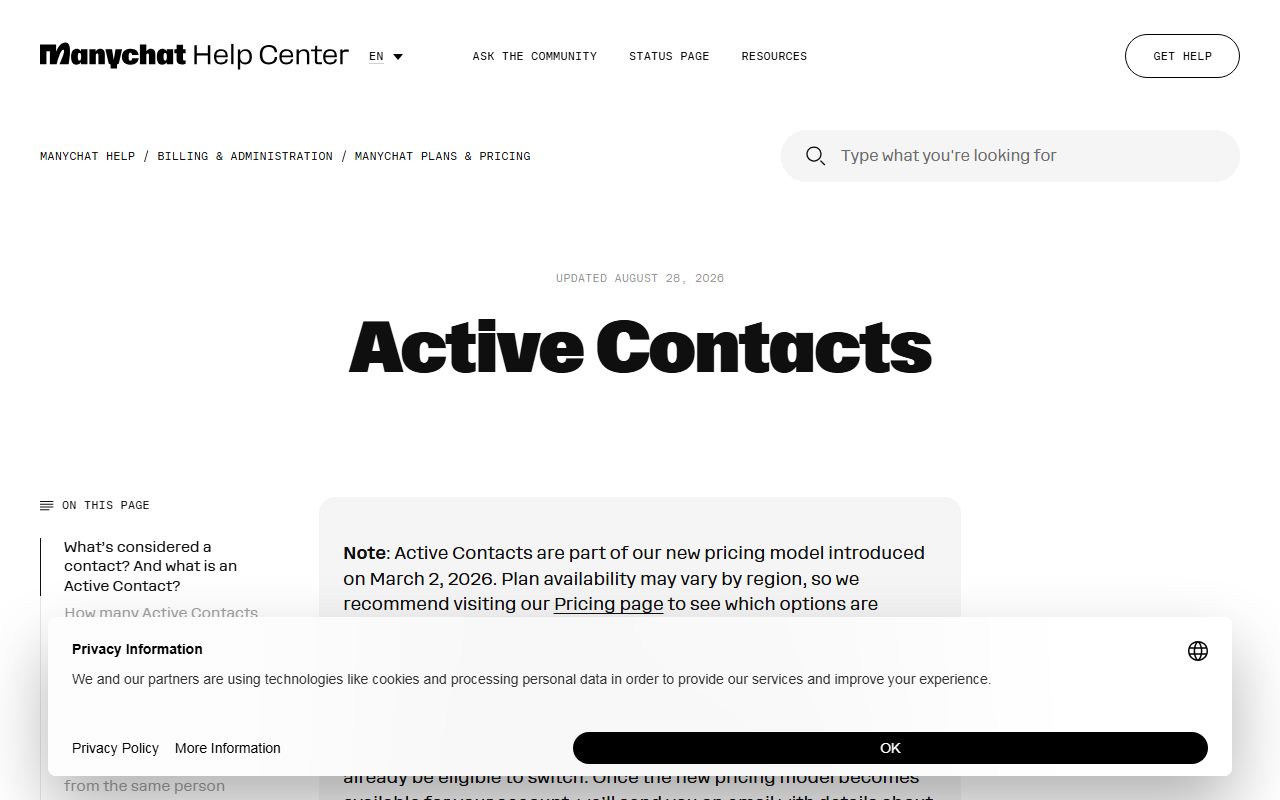
Manychat's pricing model introduced on March 2, 2026 bills on Active Contacts: people who interacted with your automations during the current billing month. Follower count is irrelevant, and a person who messages ten times counts once, per the Manychat help center checked October 9, 2026.
Included allowances scale by plan: Free 25, Essential 250, Pro 2,500, Business 7,500 and Advanced 25,000 Active Contacts per month.
Overage is automatic. Essential charges $0.10 per additional Active Contact, Pro $0.05 and Business $0.025; Advanced is custom. Fees land on the next bill, with alerts at 70, 90 and 100 percent of the limit. Automations keep running unless growth far exceeds the plan cap.
The Pro plan costs $39 per month, or $29 billed annually, which also lowers overage to $0.038 per contact. Pro allows 3 users and 2 Inbox seats, expandable to 3 at $25 per extra seat.
Caveat: the new plans apply by default to accounts created on or after March 2, 2026. Older accounts may still sit on the legacy Pro table, which scaled by total contacts, until Manychat migrates them. Availability varies by region.
Meter Brevo by emails sent, then watch the seat add-on
Brevo's marketing platform bills on email volume, not contacts. Per the Brevo pricing page checked October 9, 2026, Starter lists at $9 per month, Standard at $18 and Professional at $350. Yearly billing is 10 percent less, and Enterprise is quote-based.
Starter and Standard include 5,000 emails per month. Sending more moves you up a bracket. On Starter, 5,001 to 10,000 emails adds $8 per month and 80,001 to 100,000 adds $73. Standard's same top bracket adds $121; its brackets run to 500,000 emails.
Professional includes 150,000 emails, with 150,001 to 250,000 adding $249 per month. These figures are the editors' reading of Brevo's published tier table. Brevo does not state a separate per-email overage rate for crossing a bracket mid-month.
Seats are the hidden second meter. Starter includes 1 marketing seat and Standard 1 to 3; extra marketing seats on either cost $12 per month. Professional includes 10 seats. Sales Platform seats are priced separately at $31 (Essential) or $65 (Advanced) per month.
The Free plan allows up to 300 emails per day once the account is approved for sending. By the editors' arithmetic that caps a free sender at roughly 9,000 emails in a 30-day month. SMS and WhatsApp credits are sold separately.
Treat Close as per user, with usage riding on top
Close is the purest per-seat model. Per the Close pricing page (checked October 9, 2026), per-user monthly figures are: Solo $19 or $9, Essentials $49 or $35, Growth $109 or $99, Scale $149 or $139; the FAQ ties the lower figure to annual billing.
Minimums run the other way here. Solo is capped at 1 user and 10,000 leads, so a second hire forces an upgrade. No minimum seat count is stated for the other plans, and leads are unlimited from Essentials upward.
AI credits run per user per month, from 500 on Solo to 2,000 on Scale, with pooled caps of 10,000 on Essentials, 15,000 on Growth and 20,000 on Scale. They refresh monthly with no rollover; extra credits are sold at an unlisted price.
Calling is passed through at cost: most outbound calls run about $0.02 per minute and phone numbers start around $1 per line per month. Call Assistant adds $50 per organization monthly plus $0.02 per minute. The 14-day trial includes $5 of usage credit.
Run this checklist before you sign any lead-gen contract
- Name the meter: seat, contact, volume or credit, and note whether two meters stack. Apollo stacks credits on seats; Manychat stacks seats on contacts.
- Find the overage rule: automatic per-unit fee (Manychat), bracket jump (Brevo), recurring add-on purchase (Apollo) or pass-through usage (Close calling).
- Check rollover: Apollo and Close both expire unused credits at the end of each billing cycle.
- Check the export ceiling: Apollo's 10,000-record one-click export applies only where no selection limit is set on your plan.
- Check seat caps and floors: Close Solo stops at 1 user, Brevo Starter at 1 marketing seat, Manychat Pro at 3 users.
- Check annual terms: Close annual downgrades take effect at term end; Manychat annual billing lowers Pro overage to $0.038 per contact.
- Model your busiest month, not your average. Volume and contact meters punish spikes; seat meters punish idle logins.
Bottom line
Compare meters before prices. For a small team revealing contact data, Apollo's cost is seats plus credits, and the credits expire monthly. For DM automation, Manychat's bill follows engaged contacts, with per-contact overage that annual billing softens.
For email volume, Brevo rewards steady sending and charges for spikes and extra seats. For a calling-heavy sales team, Close is per user with usage passed through at cost.
Pull exact figures from each vendor's page on the day you buy. Manychat changed its model in March 2026, and Apollo's seat prices are not on its public page.
Frequently asked questions
Does Apollo charge per user or per credit?
Both. Every user needs a seat on the same plan level, and the whole team shares one pooled credit allotment for emails, phone numbers and AI-researched data. Credits reset each billing cycle and do not roll over, per Apollo's pricing page checked October 9, 2026.
What happens if I go over my Manychat contact limit?
Automations keep running and overage is billed automatically: $0.10 per extra Active Contact on Essential, $0.05 on Pro ($0.038 on annual) and $0.025 on Business, per the Manychat help center checked October 9, 2026. Alerts arrive at 70, 90 and 100 percent of the limit.
Is Brevo priced by contacts or by emails?
By emails sent per month. Starter and Standard include 5,000 emails and step up through published brackets; Professional includes 150,000. Seats are a separate meter, with extra marketing seats at $12 per month on Starter and Standard, per Brevo's pricing page checked October 9, 2026.
Sources
- Apollo.io pricing page (checked Oct 9, 2026)
- Manychat help center: Active Contacts (checked Oct 9, 2026)
- Manychat help center: Pro plan (checked Oct 9, 2026)
- Brevo pricing page (published Markdown pricing document) (checked Oct 9, 2026)
- Close pricing page (checked Oct 9, 2026)