Free Trial or Free Plan: Which to Start With
monday.com trials its Pro plan for 14 days, Semrush for 7, QuickBooks and FreshBooks for 30, while Asana, Trello and Slack push you toward a free tier or a promotion instead. The right starting point depends on what you need to learn before paying. A method, read from six pricing pages as of October 2026.
This article is a documentation review: it is based on the vendors' own published pages, checked on the date shown. We may earn a commission from some links; it never affects what we recommend.

A free trial and a free plan answer different questions. The trial shows what the paid product does, for a fixed number of days, usually at the top tier. The free plan shows what you can live with indefinitely, under caps the vendor chose. Picking the wrong one wastes the evaluation. This note reads how monday.com, Semrush, QuickBooks, FreshBooks, Asana, Trello, Calendly and Slack structure their trials, free plans and first-period discounts, as published on October 10, 2026, and sets out when each is the better first step.
Know which of the three doors the vendor actually opens
Vendors offer some mix of three things: a time-limited trial of a paid plan, a permanent free plan with caps, and a first-period discount. Few offer all three, and the pricing page often names only one of them clearly.
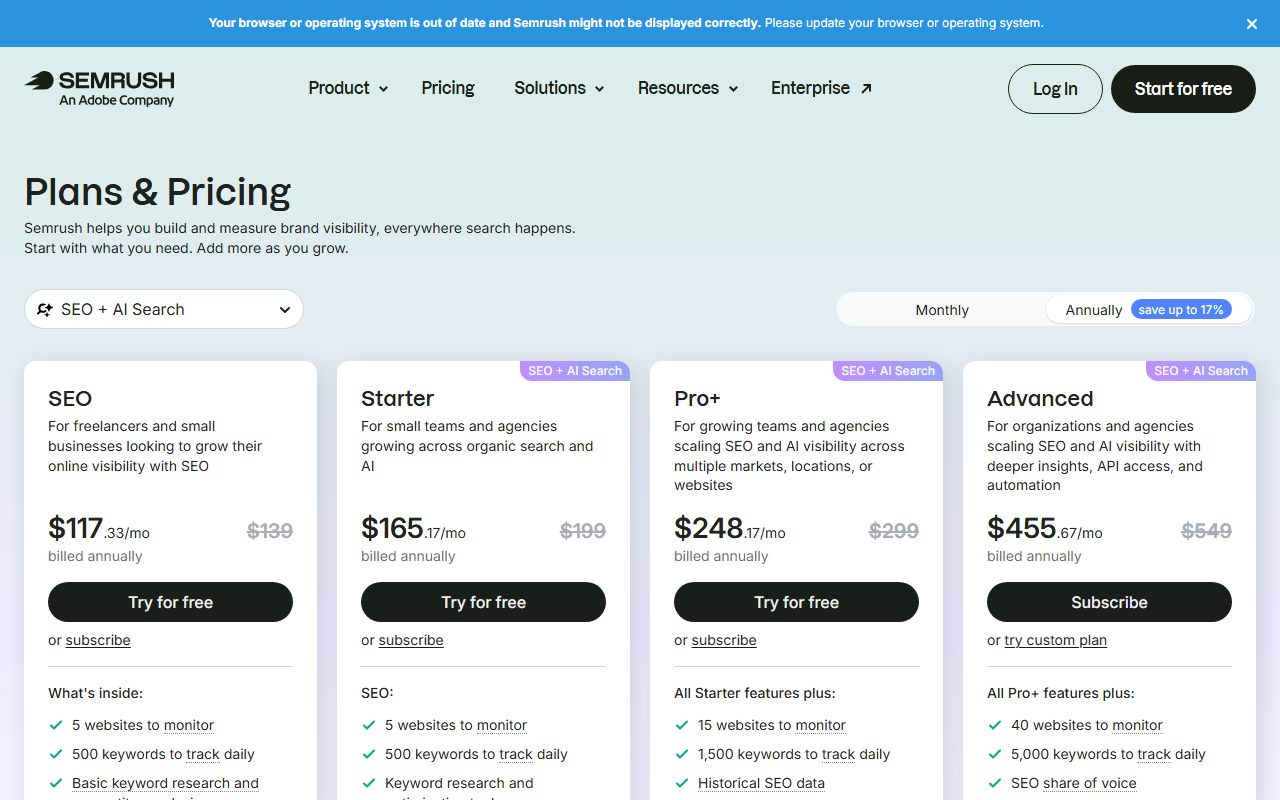
monday.com offers all three in some form: a free plan for up to 2 seats and 3 boards, a 14-day trial of Pro, and annual discounts. Semrush offers a free account limited to 1 project and 10 reports a day, plus a 7-day trial. Slack offers a free plan and a 50% discount for 3 months, but no trial is listed.
Asana's pricing page lists a free Personal plan for 2 users and does not mention a trial. Trello says any user can start a Premium trial but does not state its length. Calendly's free plan allows one event type and one calendar; its FAQ refers to a trial without giving the length on the page as read.
Use the trial when the question is about paid features
A trial of the top tier is the right tool when the decision hinges on a feature that only exists on a paid plan: automations, timeline views, permissions, integrations, reporting. Fourteen days on monday.com Pro is enough to build one real workflow and see whether the team uses it.
The trap is that the trial shows you the plan you may not buy. monday.com trials Pro at $19 per seat; the plan most small teams land on is Basic at $9 or Standard at $12. Before the trial ends, switch the workspace to the tier you intend to pay for and check what disappears.
Short trials need a plan. Semrush's 7 days are enough to run a site audit and a keyword export, not enough to measure a ranking change. Decide the two or three checks you will run before the clock starts.
Use the free plan when the question is about habit
A free plan answers whether the team will open the tool at all. Two people on Asana Personal or monday.com free, or ten collaborators on Trello's 10 free boards, can run a real project for months. If nobody logs in, no paid feature would have changed that.
The caps tell you when the free plan stops being a test. Slack's free plan keeps messages searchable for 90 days, so the first time someone needs a four-month-old thread is the upgrade trigger. Trello caps boards at 10 per Workspace and automation at 250 runs a month. Calendly caps event types at one.
Those cliffs are the same shape as the record and user limits in how to compare CRM free plans. Write down which cap you will hit first and what the first paid tier costs on that day.
Watch for a trial that competes with a discount
QuickBooks Online's pricing page lists a free trial for 30 days and, separately, 50% off for 3 months on Simple Start, Essentials, Plus and Advanced. The page does not say whether a customer can take both. Many vendors make the two offers exclusive; this page is silent.
Editorial calculation on Simple Start, list price $38. The discount path costs 3 x $19 plus 9 x $38, which is $399 in year one. The trial path costs 11 x $38 after a free month, which is $418. The discount is worth $19 more than the trial, if the two are exclusive, and the trial is worth more as an evaluation.
FreshBooks lists a 30-day trial with no credit card required and, separately, promotional pricing: Lite at $1 a month for one year against a $23 list price, Plus and Premium at 80% off for 3 months. Again the page does not say whether trial and promotion stack. Ask before starting either.
Slack's version is a time window rather than a trade-off: the 50% off for 3 months applies to eligible online purchases made within the first 7 days of creating a team. A team that uses the free plan for a month first loses the promotion. The arithmetic on whether that promotion beats annual billing is in what annual billing discounts actually save.
Check whether the trial asks for a card
FreshBooks states no credit card required for its 30-day trial. Semrush states no credit card required for its free account but does not say so for the 7-day trial. QuickBooks, monday.com, Trello and Calendly do not address the card question on the pricing pages read for this note.
A card on file at the start of a trial turns the end of the trial into a charge unless someone cancels, often at the annual rate if that toggle was left on; the cost of that mistake is in what annual billing discounts actually save. That is a calendar entry, not a reason to avoid the trial. But for a team evaluating three tools at once, three card-backed trials ending in the same week is a predictable mistake.
Pick the starting door in this order
The sequence below comes from the eight pricing pages read for this note and from the shape of the decision, not from any vendor's preference:
- If a first-period promotion has a deadline, as Slack's 7-day window does, decide whether you want it before touching the free plan
- If the decision depends on a paid-only feature, take the trial, and downgrade the workspace to your intended tier before it ends
- If the decision depends on adoption, start on the free plan and note the first cap you will hit: 90 days of history on Slack, 10 boards on Trello, 2 users on Asana
- If a trial and a discount both exist, as at QuickBooks and FreshBooks, ask whether they stack before starting either; the pages do not say
- Set a calendar reminder for any card-backed trial on the day before it ends
Whichever door you take, price the exit at the same time: the entry paid tier, the seat minimum and the annual toggle. Those three are worked through for project management tools in how to compare project management software pricing and for lead-gen tools in how lead-gen tools bill.
Bottom line
Trial when the question is a feature, free plan when the question is a habit. Take the trial at the tier you will buy, not the tier the vendor shows you. And when a page offers both a trial and a discount without saying whether they stack, as QuickBooks and FreshBooks do as of October 10, 2026, ask first.
The caps on a free plan are the real pricing page. For contact-based tools they are list sizes, as shown in what contact limits mean in email marketing tools; for seat-based tools they are users and boards. Find the cap, price the day you cross it, and the trial-or-free question mostly answers itself.
Frequently asked questions
How long is the monday.com free trial?
monday.com's pricing FAQ states a 14-day free trial of the Pro plan for Work Management, CRM and dev, as of October 10, 2026. The free plan is separate: up to 2 seats, 3 boards and 3 docs. Paid plans start from 3 users at $9, $12 or $19 per seat per month billed annually.
Does QuickBooks let you use the 30-day trial and the 50% discount together?
The pricing page read on October 10, 2026 lists both a 30-day free trial and 50% off for 3 months but does not say whether they can be combined. On Simple Start at $38, the discount path is $399 in year one and the trial path $418, by editorial calculation.
Does the Semrush free trial require a credit card?
The pricing page says the free account needs no credit card and offers a 7-day trial that can be cancelled anytime, but it does not state whether the trial itself requires a card. The free account is limited to 1 project and 10 reports a day.
Is a free plan better than a free trial for a small team?
For testing adoption, yes: a free plan with no deadline shows whether people use the tool. For testing a paid feature, a trial is better. The free plan's caps decide the upgrade date, for example Slack's 90-day message history or Trello's 10 boards per Workspace.
Sources
- monday.com pricing (14-day Pro trial, free plan 2 seats and 3 boards, plans start from 3 users) (checked Oct 10, 2026)
- Semrush plans and pricing (7-day trial, free account 1 project and 10 reports a day, no credit card for free account) (checked Oct 10, 2026)
- QuickBooks Online pricing (30-day free trial, 50% off for 3 months, Simple Start $38) (checked Oct 10, 2026)
- FreshBooks pricing (30-day trial, no credit card required, Lite $1 a month for one year promotion) (checked Oct 10, 2026)
- Asana pricing (Personal free for 2 users; no trial stated) (checked Oct 10, 2026)
- Trello pricing (free plan 10 boards, 10 collaborators, 250 command runs; Premium trial length not stated) (checked Oct 10, 2026)
- Calendly pricing (free plan one event type and one calendar connection) (checked Oct 10, 2026)
- Slack pricing (free plan 90-day message history, 50% off for 3 months within first 7 days) (checked Oct 10, 2026)