How Mid-Term Seat Changes Are Prorated on a SaaS Bill
Adding a seat in the middle of a billing period is prorated almost everywhere. Removing one is a different story at every vendor. What the Slack, Atlassian, Google Workspace and Microsoft 365 billing documents say, read October 23, 2026.
This article is a documentation review: it is based on the vendors' own published pages, checked on the date shown. We may earn a commission from some links; it never affects what we recommend.

Pricing pages describe a steady state: this many seats, this much per seat, every month. Real teams are not steady. Someone joins on the ninth, someone leaves on the twentieth, and the invoice that arrives is not the one the plan card implied.
The rule to learn is asymmetric: adding a seat mid-cycle is prorated almost everywhere, while removing one is prorated almost nowhere. This note sets out what four vendors state in their own billing documentation, read on October 23, 2026.
The underlying model is covered in how per-user pricing works with contractors.
Four behaviours, and the vendor picks which one you get
Every policy read here falls into one of four patterns. Only the first is what most buyers assume they bought.
- Prorated both ways: added seats charged for days used, removed seats refunded or credited.
- Prorated up only: additions charged pro rata, removals produce nothing until renewal.
- Maximum-quantity billing: the bill follows the highest headcount reached in the period.
- Locked term: additions prorated, removals impossible until the contract renews.
Slack prorates in both directions and pays you in credits
Slack's Fair Billing Policy is the closest of the four to the model buyers expect. On adding people mid-cycle it states: "we'll only charge for the time used. We'll keep track of this for you, and bill you accordingly."
The document shows the sum. For a member added with 20 days left on a monthly credit card subscription it gives "($8.75 ÷ 30 days) x (20 days) = $5.83", billed the following month.
Deactivation runs the same formula the other way. The policy states that "we'll add prorated credits* to your Slack account. Those credits will be applied toward future payments", and shows "($8.75 ÷ 30 days) x (15 days) = $4.38".
Read the asterisk. The credits are applied to "new members being added to your workspace or your next renewal date", and the document states that "Credits have no currency or exchange value, are non-transferable and non-refundable".
So money does come back, but as account credit rather than cash, and only when you next spend. For a team that churns seats regularly that is close to a real refund. For a team that is shrinking it is not.
Atlassian bills the highest headcount you reached
Atlassian publishes the opposite rule and names it. Its documentation defines the base: "The number of users you have at the start of your billing period is called your billed user quantity."
Additions are prorated and the base moves up. The document states: "You'll be charged a prorated cost for each additional user and these prorated costs will be added to your next invoice."
Its worked example: Melissa starts a monthly subscription with 10 users charged at USD 18 each, a USD 180 estimate. Five days in she adds 3 users, and her billed user quantity rises from 10 to 13.
Her next bill breaks down as "13 x users (total billed user quantity next month) = USD 234" plus "3 x users added (prorated costs x 25 days daily) = USD 45", giving a "Next bill estimate = USD 279".
Removal is where the model bites. The document states flatly that "there won't be any deductions, refunds or credits from your billed user quantity".
In the matching example, Armando removes 3 of his 10 users five days in and his billed user quantity does not change.
The practical consequence is a sequencing rule: remove departed users before you add new ones, because the peak sets the bill. Seat floors behave the same way, as described in what a minimum seat count does to small team pricing.
Google Workspace splits the behaviour by plan, not by vendor
Google is the useful case because the same product behaves two ways depending on which payment plan you chose at signup.
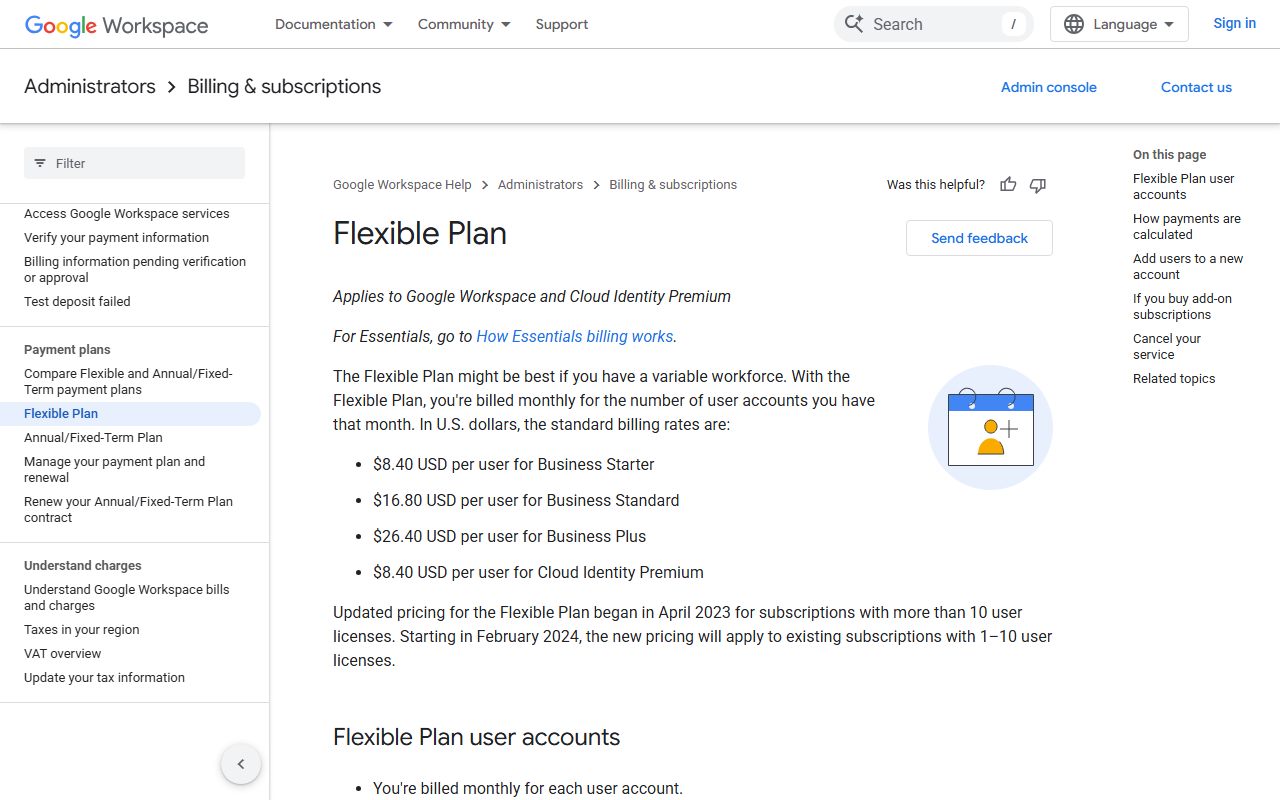
On the Flexible Plan the documentation states: "If you add or remove users during any month, your payments are prorated.
For example, if you add a user on April 1 and delete them on April 15, you are charged for only half a month of service for that user."
There is a carve-out worth reading twice: "In some cases, if you remove a user's add-on license or delete a user with an add-on license during the month, we charge you for the full month for that license."
That is the pattern to watch generally. The base seat prorates; the add-on attached to it may not. Add-on line items behave unpredictably, which is also true of the AI charges set out in what AI costs inside a plan you already pay for.
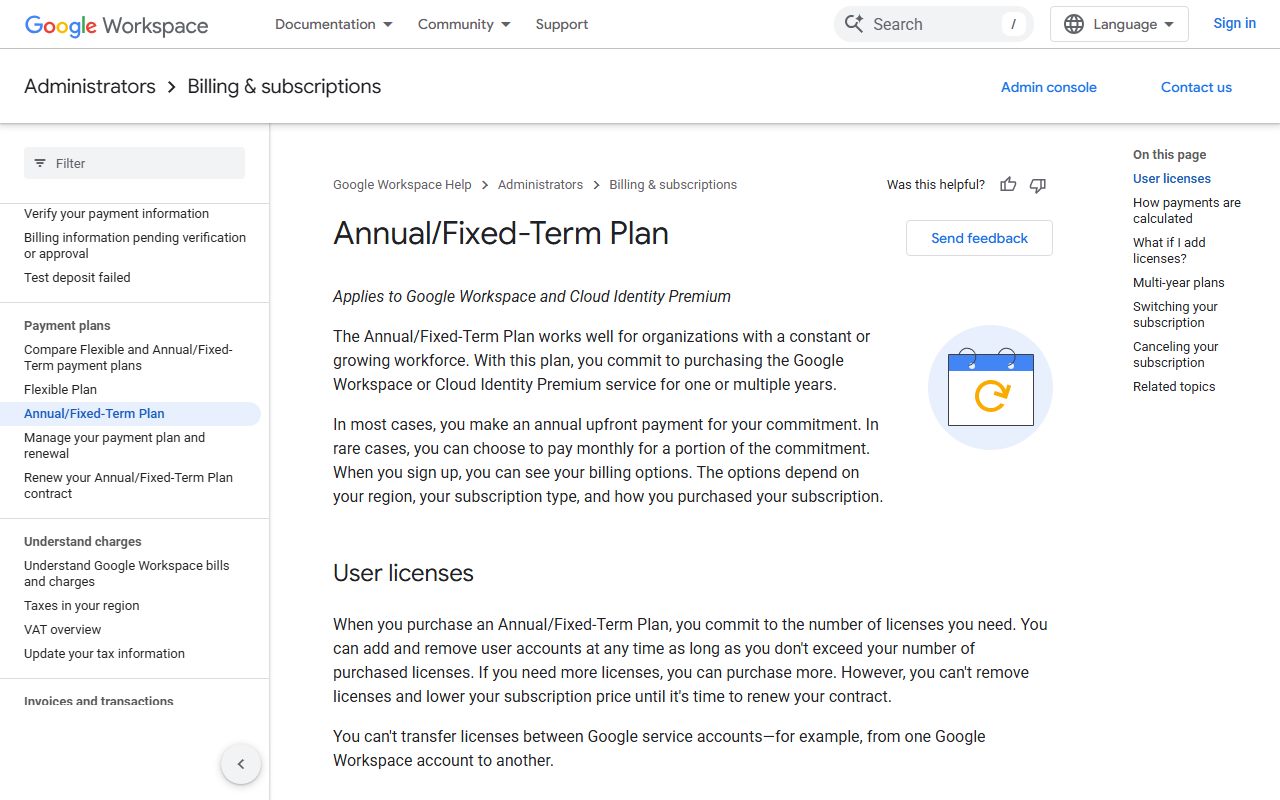
The Annual/Fixed-Term Plan is the locked-term pattern. Its documentation states that "User licenses that you purchase after the initial commitment are prorated", and then that "You can't remove licenses and lower your subscription price until it's time to renew your contract."
Its example prices 3 licenses bought on the sixth day of the fourth commitment month as "(3 x $84 USD per license per year)/12 months prorated for 24 days", or $16.80 added to the $49 charged for the original 7 licenses.
That is the trade behind every annual commitment: a lower rate in exchange for losing the right to shrink. The rate side of the same trade is in what annual billing discounts actually save.
Microsoft 365 gives you a seven-day window to undo a purchase
Microsoft's documentation makes the timing explicit, and the rule depends on which billing account type you have.
On a Microsoft Customer Agreement account it states: "you can only remove licenses from your subscription if it's within seven days of buying or renewing your subscription".
It adds that if you buy mid-period, "you have seven days from when you buy them to reduce the number of licenses you bought".
Miss that window and the change waits. The document states that a later reduction "appears on the first invoice you receive after the subscription renewal date".
On a Microsoft Online Subscription Agreement account the invoice is rebuilt instead: "the previous charge for the original number of licenses is deducted on your next invoice.
We add a prorated charge for the time period with the original number of licenses and add a charge for the new license count."
One more operational detail: "You can't reduce the number of licenses for your subscription if all licenses are currently assigned to users." Unassign first, then remove, or the button does nothing.
What to check before you change seats mid-cycle
- Find out whether removals are credited, ignored, or locked until renewal before you hire.
- Remove departed users before adding new ones, which matters most on maximum-quantity billing.
- Check whether a refund arrives as cash or as account credit, and when that credit can be spent.
- Check the add-on lines separately, since they may be charged for the full period regardless.
- Note any cancellation window in days, as on Microsoft Customer Agreement accounts.
- On an annual term, assume headcount can only go up until renewal day.
Support tools deserve the same pass, because seats and consumption are often billed differently there; see how help desks price seats and AI resolutions.
Bottom line
Adding a seat mid-cycle costs a fraction of the month at all four vendors. Slack shows $5.83 for 20 days of an $8.75 seat. Atlassian adds USD 45 for three users over 25 days. Google adds $16.80 for three annual licenses over 24 days.
Removing a seat is where they diverge. Slack issues non-refundable credit. Atlassian issues nothing. Google prorates on Flexible and refuses on Annual. Microsoft allows it for seven days, then waits for renewal.
Price a team at its peak headcount, not its average, and check the removal rule before the annual discount tempts you. The same billing questions applied to one category are in how to read a video conferencing pricing page.
Frequently asked questions
Do SaaS vendors refund seats removed mid-cycle?
Rarely as cash. Slack adds prorated credits that are "non-transferable and non-refundable". Atlassian states there are "no deductions, refunds or credits". Google prorates on its Flexible Plan but not on the Annual Plan. Checked October 23, 2026.
How is a seat added mid-month calculated?
By days used. Slack's policy shows "($8.75 ÷ 30 days) x (20 days) = $5.83". Google's annual example shows "(3 x $84 USD per license per year)/12 months prorated for 24 days", which it totals as $16.80.
What is maximum quantity billing?
Billing based on the highest user count reached during the period. Atlassian defines the billed user quantity as the number of users at the start of the period, raises it when you add users, and does not lower it when you remove them.
Should I remove users before adding new ones?
On maximum-quantity billing, yes. Atlassian's own example shows a user count of 13 after three additions, which then becomes the starting quantity for the next month. Removing first keeps the peak lower.
Can I reduce licenses on an annual SaaS contract?
Usually not until renewal. Google states you "can't remove licenses and lower your subscription price until it's time to renew your contract". Microsoft allows reductions within seven days of purchase or renewal on MCA accounts.
Are add-ons prorated like seats?
Not always. Google's Flexible Plan documentation states that in some cases removing a user's add-on license, or deleting a user who holds one, is charged for the full month even if it happens mid-period.
Sources
- Slack Fair Billing Policy (prorated charges, prorated credits, credit terms) (checked Oct 23, 2026)
- Atlassian: how maximum quantity billing works (billed user quantity, worked examples) (checked Oct 23, 2026)
- Google Workspace Flexible Plan (per-day proration, add-on license carve-out) (checked Oct 23, 2026)
- Google Workspace Annual/Fixed-Term Plan (prorated additions, no mid-term reductions) (checked Oct 23, 2026)
- Microsoft 365: buy or remove licenses (seven-day window, MOSA proration, invoice timing) (checked Oct 23, 2026)