How Automation Tools Price Runs and Operations
Four automation vendors sell the same outcome and count it four different ways. Zapier meters tasks, n8n meters one execution per whole workflow, Pipedream meters credits worth 30 seconds of compute each, and Make meters every module run. Pricing pages read October 29, 2026.
This article is a documentation review: it is based on the vendors' own published pages, checked on the date shown. We may earn a commission from some links; it never affects what we recommend.
Automation tools do not disagree about price so much as about counting. The same nightly job can bill as 1 unit on one platform and 40 on another, and the headline rate hides all of it.
Zapier meters tasks. n8n meters one execution per workflow run. Pipedream meters credits worth 30 seconds of compute. Make meters every module that fires, including the ones that find nothing.
Three of those four pricing pages could be read directly on October 29, 2026. Make's could not, and the reason is worth recording as well.
The unit decides what a busy month costs
Start with a plain job: watch a spreadsheet, filter rows, write to a CRM, send a Slack message. Four steps, running once an hour, is what most small teams actually buy.
On n8n that is one execution per run. The pricing page is explicit: "An execution is a single run of your entire workflow. It doesn't matter how many steps are in the workflow or how much data it processes."
On Make the same job is closer to four credits, because credits track module runs rather than workflow runs. Add a step and the monthly bill moves.
That is the whole comparison in one sentence. A per-run unit rewards complex workflows, and a per-step unit rewards short ones.
The habit of selling a counter rather than a feature set shows up across categories. How form builders price responses and submissions covers the same pattern on a simpler page.
Zapier sells a task ladder, and the card shows only the bottom rung
Zapier's plan cards list Free at $0 a month, Professional "starting from $19.99 /month" and Team "starting from $69 /month" with 25 users. Enterprise is routed to sales.
The Free description in the page's own structured data reads "Zaps, Tables, and Forms included (100 tasks per month)". So $0 buys roughly three tasks a day.
The words "starting from" are load-bearing. A selector on the page offers sixteen task tiers, and the price follows whichever rung is chosen.
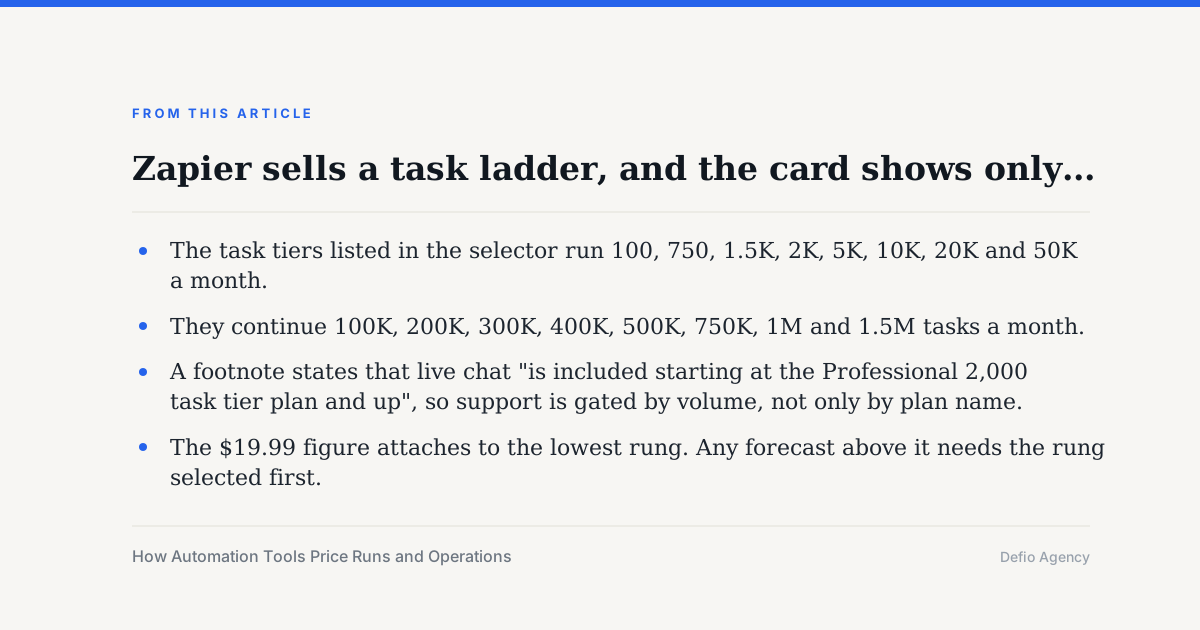
- The task tiers listed in the selector run 100, 750, 1.5K, 2K, 5K, 10K, 20K and 50K a month.
- They continue 100K, 200K, 300K, 400K, 500K, 750K, 1M and 1.5M tasks a month.
- A footnote states that live chat "is included starting at the Professional 2,000 task tier plan and up", so support is gated by volume, not only by plan name.
- The $19.99 figure attaches to the lowest rung. Any forecast above it needs the rung selected first.
We could not read the price attached to each individual rung on October 29, 2026, so no mid-ladder figure is quoted here. The $19.99 and $69 entry points are the only Zapier rates confirmed in the page itself.
A ladder priced by volume behaves like a metered utility rather than a subscription. The failure modes are set out in what happens when a SaaS usage limit runs out.
n8n prices executions in euros and caps the small plans
n8n lists Starter at 20 euros a month billed annually for 2,500 workflow executions, Pro at 50 euros for 10,000, and Business at 667 euros for 40,000. Enterprise is custom.
The page quotes euros, not dollars, which matters for a US budget line. An annual toggle advertises "Save 17%", but the monthly-billed figures were not readable, so they are not quoted.
The overage policy is the sharper detail. A note on the comparison table says Starter and Pro "are capped and have no overages", while Business overage is listed at 4,000 euros or $4,800 per extra 300,000 executions.
Capped means the work stops. For a team that would rather pay than stall, a capped plan is a risk and not a protection.
AI sits on a second meter. The table lists 1,600 Assistant credits a month on Starter, 4,000 on the Pro 10k plan and 9,600 on Pro 50k, refreshing monthly without rollover.
Two meters on one invoice is now normal. What AI costs inside a plan you already pay for works through how those allowances are usually drawn.
Pipedream splits the bill into users and compute
Pipedream lists Free at $0, Startup at $99 a month billed annually or $150 a month billed monthly, and Business as custom with an annual contract.
Paying yearly is 34 percent below the monthly rate on that pair, by our arithmetic: $1,188 against $1,800 a year. That is a wider gap than most vendors offer.
Startup "includes 100 users, then $2 per user" and "10,000 usage credits included, then $0.012 each". Both overflow prices are printed, which is rarer than it should be.
The FAQ defines the credit: running an action, calling a tool through MCP, or emitting an event from a trigger "each use 1 credit per 30 seconds of compute".
So Pipedream is the only one of the four that meters wall-clock time. A slow API on the far end of your workflow raises the bill on Pipedream and changes nothing on n8n.
A published overflow rate is worth paying a little more for. The reasoning is in what annual billing discounts actually save on SaaS.
Make's pricing page would not open, but its credit rules would
Make's pricing page returned a Cloudflare interstitial reading "Just a moment" on October 29, 2026, and the markdown version of the same URL returned a 403. No Make plan price is quoted here.
The help centre is readable, and it is where the billing unit is actually defined. Its credits page states that most apps charge "a fixed rate of 1 credit per operation".
Two rules there cost real money. Trigger modules "use 1 credit per run, regardless of whether they return data", and action modules spend "1 credit per input bundle processed".
The documentation works a worked example: a search returning 10 rows costs 1 credit, the delete step that follows costs 10, and the scenario costs 11 in total.
One more line is easy to miss. The Make Code app "uses 2 credits per second of execution time", which puts a second, time-based meter inside an otherwise per-operation model.
What to settle before you pick a platform
- Write down one real workflow, then count it in each vendor's unit. The spread between a per-run and a per-step count is often five to one.
- Count empty checks. A trigger polling hourly spends roughly 720 units a month on Make whether anything happened or not.
- Ask what happens at the ceiling. n8n caps Starter and Pro; Pipedream publishes $0.012 per extra credit; Zapier moves you up a rung.
- Check the currency on the page. n8n quotes euros, which adds a conversion and a card fee to a dollar budget.
- Separate the AI meter from the automation meter. Assistant credits and usage credits run out independently.
- Read the support line. Zapier gates live chat at the 2,000-task tier rather than at a plan name.
The same discipline applies to any metered tool. Per seat, per contact or per credit and how to compare project management software pricing use it on neighbouring categories.
Before committing to a year, decide which door to walk in through. Free trial or free plan: which to start with sets out the trade-off.
Frequently asked questions
Which automation tool is cheapest for a small team?
It depends on how many steps your workflows have. On the pages read October 29, 2026, Zapier's entry rate is $19.99 a month, n8n's Starter is 20 euros a month billed annually, and Pipedream's Startup is $99 a month billed annually.
What is the difference between a task, an operation and an execution?
A Zapier task and a Make operation are both roughly one step. An n8n execution is one whole workflow run regardless of step count. A Pipedream credit is 30 seconds of compute. Four units, four different bills.
Does Zapier have a free plan?
Yes. The page lists Free at $0 a month, and the structured data describes it as including Zaps, Tables and Forms with 100 tasks per month, as read October 29, 2026.
What happens if I go over my n8n execution limit?
On Starter and Pro, nothing extra is charged because the comparison table lists both as capped with no overages. Business is listed at 4,000 euros or $4,800 per extra 300,000 executions.
How much does Make cost?
We could not read it. Make's pricing page returned a Cloudflare challenge page on October 29, 2026 and the markdown version returned a 403, so no Make plan price appears in this article.
Do empty trigger checks count against my allowance?
On Make, yes. Its credits documentation states that trigger modules use 1 credit per run regardless of whether they return data, so an idle hourly poll still spends roughly 720 credits a month.
Bottom line
Price the unit before the plan. A four-step workflow running hourly is about 720 n8n executions a month and roughly four times that in Make credits, by our arithmetic.
Then price the ceiling. Capped plans stop work, metered plans keep going and send a bigger invoice, and only one of those is acceptable for a job your customers can see.
All figures reflect the vendors' own published pages as read on October 29, 2026 and can change without notice. Confirm the task or execution tier at the checkout step before paying for a year.
Sources
- Zapier pricing (Free, Professional and Team entry rates, 100-task Free description, task tier selector, live chat footnote) (checked Oct 29, 2026)
- n8n plans and pricing (Starter, Pro and Business annual rates in euros, execution definition, overage and Assistant credit rows) (checked Oct 29, 2026)
- Pipedream pricing (Free and Startup rates, 100 included users at $2 each, 10,000 credits at $0.012 each, 30-second credit definition) (checked Oct 29, 2026)
- Make help centre, How features use credits (1 credit per operation, trigger and action module rules, Make Code at 2 credits per second) (checked Oct 29, 2026)