How to Read a Cloud Backup Pricing Page
Backup vendors bill on two incompatible units: a flat price per computer with unlimited data, or a price per terabyte with the devices counted separately. What Backblaze, Carbonite, IDrive and pCloud publish, read October 23, 2026.
This article is a documentation review: it is based on the vendors' own published pages, checked on the date shown. We may earn a commission from some links; it never affects what we recommend.

Two backup services can quote almost the same monthly figure and mean different things by it. One charges for a computer and ignores how much data sits on it. The other charges for terabytes and counts the computers as a separate limit.
Until you know which unit you are reading, the prices are not comparable. This note gathers what four vendors publish on their own pricing pages, read on October 23, 2026.
The same unit problem appears across categories, as set out in per seat, per contact or per credit.
Four billing units are in use, and pages rarely name them
Read the unit before the number. A household with one laptop and 8 TB of photos and a household with five laptops holding 200 GB each will get opposite answers from the same two vendors.
- Per computer, data unlimited: you buy devices, not gigabytes.
- Per capacity, devices unlimited: you buy terabytes and attach as many machines as you like.
- Per capacity with device and user counts bolted on: the tier fixes both at once.
- One-time purchase: the capacity is bought outright rather than rented.
Backblaze charges for the computer and does not meter the data
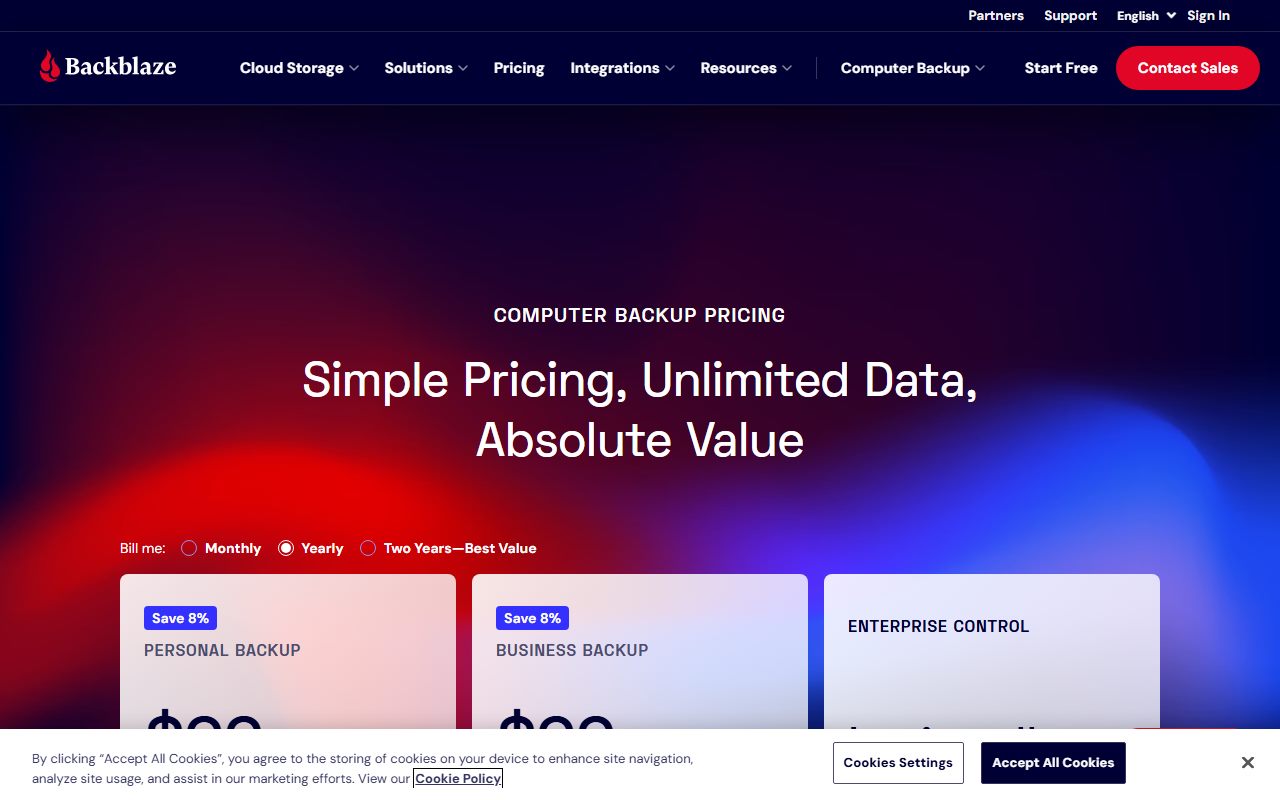
Backblaze's Computer Backup pricing page quotes three billing terms for the same product: $9 per month, $99 per year marked "Save 8%", and $189 per two years marked "Save 13%", read October 23, 2026.
The page describes the product as "Unlimited data backup" and states that "All user-generated data will be backed up from computers and connected external drives". The Personal and Business cards carry the same figures.
Editorial arithmetic on those numbers: twelve months at $9 is $108, so the $99 annual price is about 8 percent lower, which matches the badge. Two years of monthly billing would be $216 against $189.
For a single computer holding a large video library this unit is the cheap one. For a family of five laptops it is $45 a month at the monthly rate, by our arithmetic from the page's own figure.
The commitment maths is covered in what annual billing discounts actually save.
Carbonite prices one computer and quotes the year as a month
Carbonite uses the same per-computer unit with a different presentation. Its personal plans page shows Basic at $6.40 a month, with $95.99 struck through and "$76.79 /year, billed annually" beside it, marked "Save 20%", read October 23, 2026.
Plus is shown at $7.15 a month, with $131.99 struck through and $85.79 a year, marked "Save 35%". Prime is shown at $8.77 a month, with $161.99 struck through and $105.29 a year, also marked "Save 35%".
Editorial arithmetic: $76.79 divided by twelve is $6.40. The per-month figure on the card is the annual price spread over the year, not a monthly plan you can buy.
The scope differs by tier rather than by capacity. Basic is marked "For 1 computer". Plus and Prime are marked "For 1 computer + 1 external hard drive". All three are marked Unlimited for storage.
So the limit here is the device count, and a second computer means a second subscription. Three computers on Basic is $230.37 a year by our arithmetic from the page's own $76.79 figure.
IDrive sells terabytes and then counts your computers anyway
IDrive shows the other unit, and how a capacity tier can quietly carry a device limit too. Its pricing page splits three product lines across monthly, yearly and two-year tabs.
On the monthly tab, IDrive Personal is listed at $11.99 for 5 TB, $17.99 for 10 TB, $29.99 for 20 TB, $59.99 for 50 TB and $119.99 for 100 TB, with the scope marked "One user, Multiple computers".
The yearly tab shows the same 5 TB tier at $9.99 struck through and $6.99 a month, then $10.49, $17.49, $34.99 and $69.99 up the ladder.
The footnote under those figures is the one to read: "The discounted price applies to the first year of the selected plan. Standard pricing will apply from the second year onward."
IDrive Team is where capacity and headcount are welded together.
The tiers read "5 computers, 5 users (5 TB)" at $6.99 a month and "50 computers, 50 users (50 TB)" at $69.99 a month on the yearly tab, so you cannot buy 50 TB for three machines on that line.
IDrive Business removes the user cap instead: it is marked "Unlimited users, Multiple computers and servers", starting at $13.99 a month for 500 GB on the yearly tab.
Coupling a capacity tier to a fixed number of users produces the same price floor described in what a minimum seat count does to small team pricing.
The overage rate is the line that decides a capacity plan
IDrive publishes what happens when you cross the tier, which most backup pages do not. Its page states: "If you exceed account storage limit, there may be an overuse charge of $0.25/GB/month for Personal plan and $0.50/GB/month for the Team and Business plans."
Editorial arithmetic: 500 GB over a Personal tier is $125 a month at $0.25 per GB, which is more than the 100 TB tier costs. On a capacity plan the overage rate, not the tier price, sets your worst case.
The page also offers a free starting point: "You can create a free 10 GB IDrive Basic account".
Measuring your real data on a free tier first is the method in free trial or free plan; the general shape of hitting a ceiling is in what happens when a usage limit runs out.
Restores carry their own fee. IDrive lists physical shipment restores as free once a year on one line and thrice yearly on others, then states "Subsequent requests will be charged $59.95".
pCloud sells the capacity outright
pCloud's pricing page offers a fourth shape: buy the terabytes once.
Its yearly tab shows Premium 500 GB at 59.88 USD struck through and 49.99 USD, Premium Plus 2 TB at 119.88 USD struck through and 99.99 USD, and Ultra 10 TB at 359.88 USD struck through and 299.99 USD.
The lifetime tab prices the same tiers as a one-time payment: 500 GB at 279 USD reduced to 219 USD, 2 TB at 709 USD reduced to 499 USD, and 10 TB at 2,799 USD reduced to 1,499 USD, read October 23, 2026.
Editorial arithmetic: the 2 TB one-time price of 499 USD is five years of the 99.99 USD annual rate, and 10 TB at 1,499 USD is five years of 299.99 USD. The break-even is simple; the vendor's continued existence is the variable you cannot price.
Read a backup page in this order
- Count the computers and external drives that must be covered, including the ones nobody mentions.
- Measure the data today, then add a year of growth before picking a capacity tier.
- Find the overage rate per GB, since on a capacity plan it sets the worst case, not the tier price.
- Check whether a discount applies only to the first year, as IDrive states on its page.
- Check whether the per-month figure is a real monthly plan or an annual price divided by twelve.
One more line belongs on that list: how long the vendor keeps your backups after you stop paying.
The general case is in what happens to your data after you cancel, and the habit of reading capacity ceilings carefully is the same one described in what contact limits mean in email marketing tools.
Bottom line
Backblaze and Carbonite sell computers: $9 a month, $99 a year or $189 for two years per machine at Backblaze, and $76.79 to $105.29 a year per machine at Carbonite, both with unlimited data.
IDrive and pCloud sell capacity. IDrive starts at $6.99 a month for 5 TB on its first-year rate and charges $0.25 per GB per month over the tier. pCloud sells 2 TB outright for 499 USD.
Pick the unit that matches your situation, then compare prices inside that unit only. The same reading method for a different category is in how to read a video conferencing pricing page.
Frequently asked questions
Is cloud backup priced per computer or per terabyte?
Both models are common. Backblaze and Carbonite price per computer with unlimited data, at $99 a year and $76.79 a year respectively. IDrive and pCloud price per terabyte, from $6.99 a month for 5 TB and 49.99 USD a year for 500 GB.
How much does unlimited cloud backup cost?
Backblaze lists $9 a month, $99 a year or $189 for two years for one computer with unlimited data. Carbonite lists $76.79 a year for Basic on one computer, rising to $105.29 for Prime. Figures checked October 23, 2026.
What happens if I exceed my backup storage limit?
On IDrive the page states an overuse charge of $0.25 per GB per month on Personal plans and $0.50 per GB per month on Team and Business plans. That makes 500 GB of overage $125 a month on a Personal plan, by our arithmetic.
Is a lifetime backup plan cheaper than a yearly one?
On pCloud's own figures the 2 TB one-time price of 499 USD equals five years of the 99.99 USD yearly rate, and 10 TB at 1,499 USD equals five years of 299.99 USD. Whether that pays back depends on how long you keep the account.
Why do backup plans show a monthly price next to a yearly one?
Often because the monthly figure is the annual price divided by twelve. Carbonite shows $6.40 a month beside "$76.79 /year, billed annually", and $76.79 divided by twelve is $6.40. That is not a monthly plan you can buy.
Sources
- Backblaze Computer Backup pricing (monthly, yearly and two-year prices, unlimited data, proration note) (checked Oct 23, 2026)
- Carbonite personal backup plans (Basic, Plus and Prime annual prices, device scope) (checked Oct 23, 2026)
- IDrive pricing (Personal, Team and Business capacity tiers, first-year discount note, overuse charges, restore fees) (checked Oct 23, 2026)
- pCloud cloud storage pricing (yearly and one-time payment tiers) (checked Oct 23, 2026)