How Booking Tools Price Seats and Calendars
Appointment schedulers split into two camps. Calendly, SavvyCal and Cal.com bill per seat, from $10 to $12 a user a month on annual billing. Acuity bills per business with a calendar allowance, at $27 a month for up to six. The crossover point decides which is cheaper, and it arrives around three people. Pages read October 26, 2026.
This article is a documentation review: it is based on the vendors' own published pages, checked on the date shown. We may earn a commission from some links; it never affects what we recommend.

Booking tools divide into per-seat and per-calendar pricing, and the two models cross over at a team size you can calculate before you sign anything. Below that size the seat tools win; above it they stop being competitive.
Calendly Standard is $10 a seat a month on annual billing. SavvyCal Basic works out at $10. Cal.com Teams is $12. Acuity Standard is $27 a month for up to six calendars, whatever the headcount.
All four pages were read October 26, 2026. Three of them publish both a monthly and an annual rate, and the gap between those two numbers is where most quoting mistakes happen.
Calendly prices a seat, not a meeting
Calendly's embedded price data lists Standard at $12 a seat a month billed monthly and $10 billed annually, a 17 percent saving the page calculates itself. Teams is $20 monthly and $16 annually, a 20 percent saving.
The page is explicit about who needs a seat: "Seats are required for users to connect calendars and host Calendly meetings - meeting invitees do not require a seat." So volume of bookings does not move the bill.
Two newer features are sold as a bundle on top. Adding Notetaker and the Callie assistant takes Standard to $24 monthly or $18 annually, and Teams to $32 monthly or $24 annually.
That bundle is the largest single jump on the page. Standard with the add-on costs more per seat than plain Teams, which is worth noticing before choosing between the two tiers.
Metered or bundled AI is now standard practice rather than an exception. What AI costs inside a plan you already pay for covers how to price that line separately.
Enterprise is the odd entry. It "starts at $15k /yr" and "starts at 50 seats", which is $300 a seat a year by our arithmetic, or $25 a month - above the Teams annual rate of $16.
A fifty-seat floor is a real constraint rather than a formality. What a minimum seat count does to small teams describes what those floors do to a budget.
SavvyCal publishes the full arithmetic in its own FAQ
SavvyCal lists Basic at $12 per user per month billed monthly, or $120 per user per year billed annually. Premium is $20 per user per month, or $200 per user per year.
Both figures appear in the page's structured offer data as separate offers in US dollars, which makes them unusually easy to verify against the visible card.
The FAQ then explains the discount without marketing language: "Two months free. Basic is $120 per user per year instead of $144, and Premium is $200 instead of $240."
Twelve months at $12 is $144, so the annual price is exactly ten months. That is the clearest statement of an annual discount on any of the four pages in this note.
The page also states a 25 percent discount for nonprofits, educators and students, stacking with annual billing to give Basic at $90 per user per year.
Premium is not a volume tier. Per the FAQ it adds a custom booking domain, branding removal, sending from your own address, assistant delegation, and taking Stripe payments at booking.
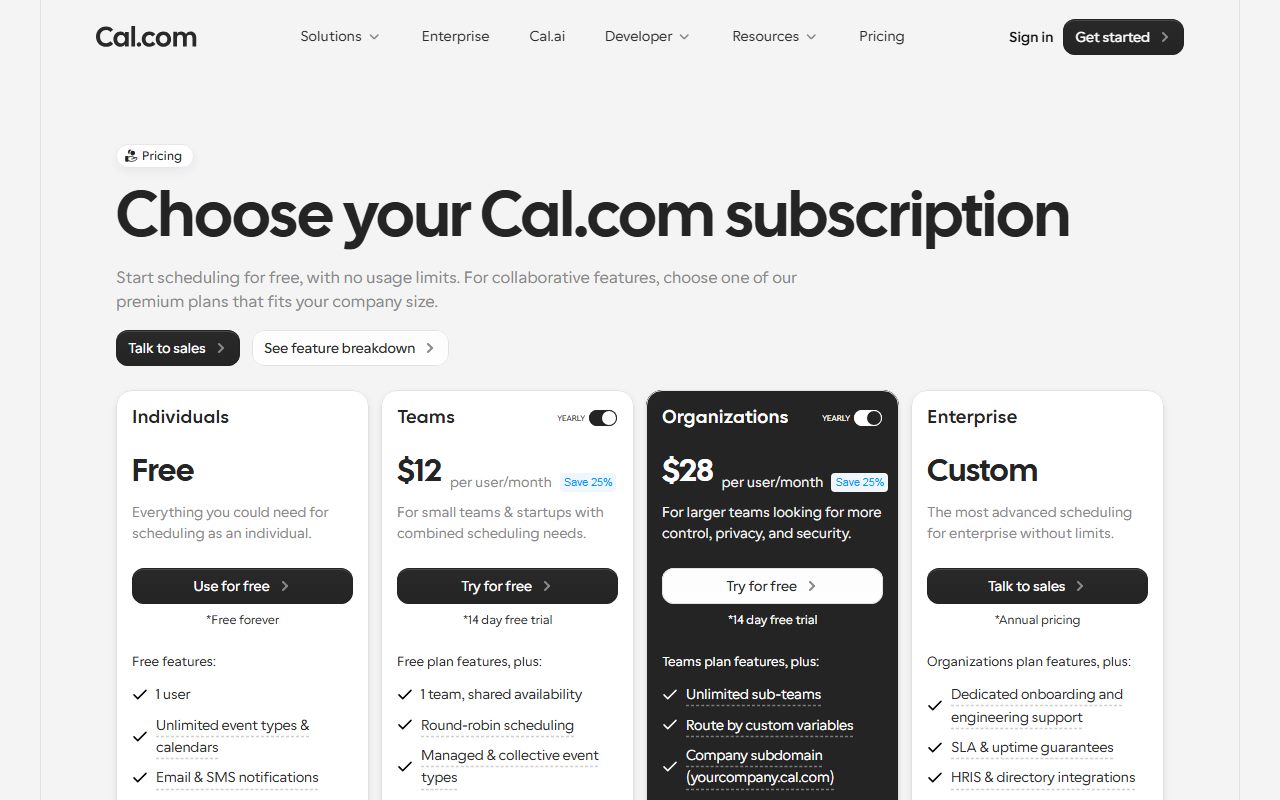
Cal.com shows the yearly rate and a saving claim
Cal.com's pricing page shows Teams at $12 per user per month and Organizations at $28 per user per month, both labelled YEARLY, with Teams carrying a "Save 25%" badge.
We could not read the monthly rate in the state the page was dumped on October 26, 2026, so we are not printing a figure for it. The 25 percent claim is the vendor's own.
The free tier is described as everything needed for scheduling as an individual, which makes Cal.com the only one of the four with a free plan aimed squarely at solo use.
Whether a free tier beats a trial depends on what you are testing. Free trial or free plan: which to start with sets out the trade.
Acuity sells calendars and ignores your headcount
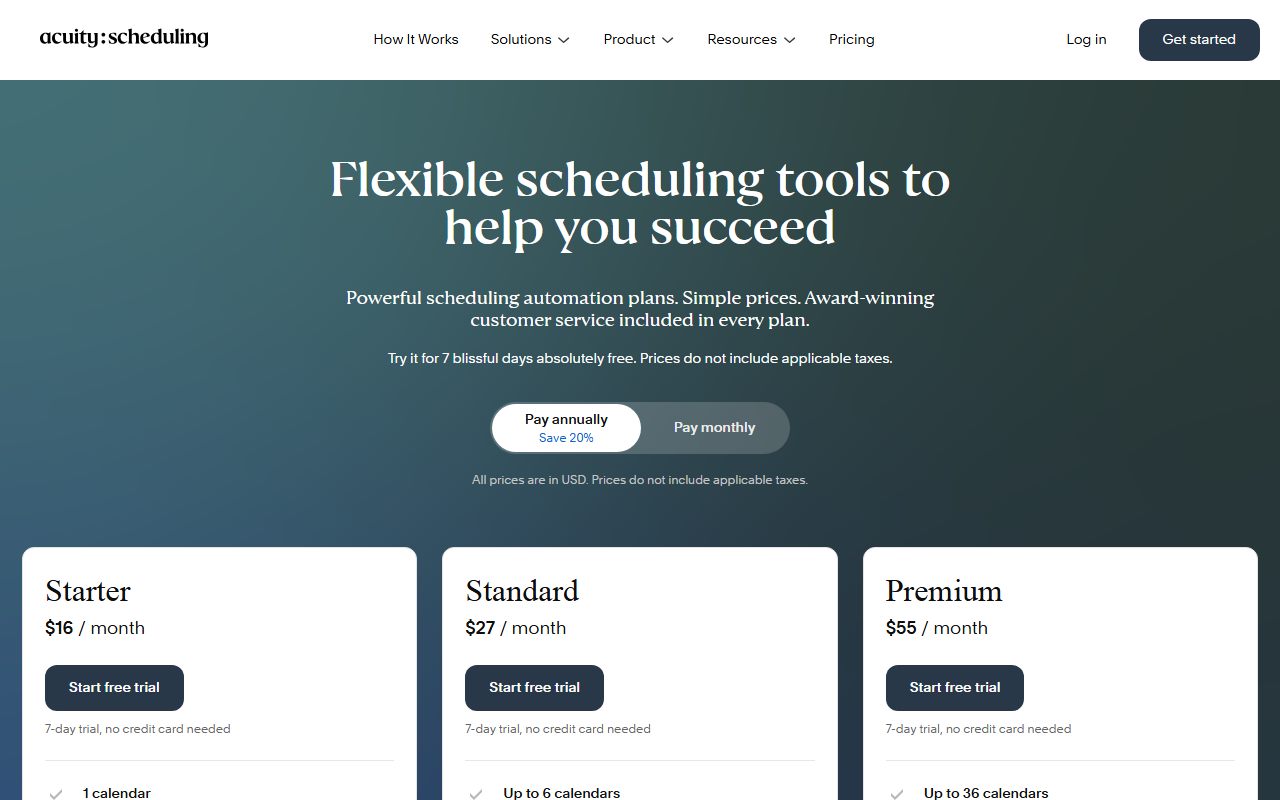
Acuity's three plans are priced per business with a calendar allowance. Starter is $16 a month on annual billing, $20 monthly, for one calendar. Standard is $27 annually and $34 monthly for up to six.
Premium is $55 a month on annual billing and $69 monthly, for up to 36 calendars. The page explains a calendar as a separate one per employee or location, depending on business needs.
All three carry a seven-day trial with no credit card required. That is shorter than the fourteen-day norm elsewhere, and short enough that it needs planning rather than browsing.
The important structural point is that nothing in Acuity's price moves with headcount beyond the calendar count. Six staff on Standard cost the same $27 as two staff on Standard.
Where the two models cross over
The figures below use the annual-billing rates above and are our arithmetic, not the vendors'. They assume one calendar or one seat per person and exclude tax.
- One person: Cal.com free, Calendly Standard $10 a month, SavvyCal Basic $10, Acuity Starter $16.
- Three people: Calendly $30 a month, SavvyCal $30, Cal.com Teams $36, Acuity Standard $27.
- Six people: Acuity Standard still $27 a month, against Calendly $60, SavvyCal $60 and Cal.com $72.
- Twelve people: Acuity Premium $55 a month, against Calendly $120, SavvyCal $120 and Cal.com $144.
- Fifty people: Calendly Teams $800 a month, against the Enterprise floor of $15,000 a year, which is $1,250 a month.
The crossover sits at about three people. Below it the seat tools are cheaper and simpler; above it the calendar allowance pulls away and keeps pulling away as the team grows.
That does not make Acuity the answer. It is built around service businesses taking client bookings, where the seat tools are built around internal meetings, and the feature lists reflect that.
Short-term staff change the maths again on any per-seat plan, as described in how per-user pricing works with contractors.
What to check before paying for a year
- Whether the price is per seat or per business, and what the vendor counts as a seat or a calendar.
- Whether the displayed rate is the monthly or the annual one, then divide the annual total by twelve yourself.
- Whether the features you came for sit in a tier or in a paid add-on, as Calendly's Notetaker bundle does.
- Whether a seat floor applies on the plan above the one you want, as it does at fifty seats on Calendly Enterprise.
- How long the trial runs. Acuity's is seven days with no card; Calendly and SavvyCal publish free or trial access on their own terms.
- Whether a nonprofit or education discount applies, as SavvyCal states at 25 percent stacking with annual billing.
The same two-camp split shows up in other tool categories. How to compare e-signature pricing and how to compare project management software pricing describe the per-document and per-seat versions of the same problem.
For the arithmetic behind every annual figure quoted here, see what annual billing discounts actually save on SaaS.
Frequently asked questions
How much is Calendly per user?
Standard is $12 a seat a month billed monthly and $10 billed annually. Teams is $20 monthly and $16 annually. Adding the Notetaker and Callie bundle raises those to $24 and $18 on Standard, per the page read October 26, 2026.
Is Acuity cheaper than Calendly?
Above about three people, yes. Acuity Standard is $27 a month on annual billing for up to six calendars, where six Calendly Standard seats cost $60 a month on annual billing. At one person Calendly is cheaper, at $10.
Does Calendly charge for people who book meetings?
No. The pricing page states that seats are required for users who connect calendars and host meetings, and that meeting invitees do not require a seat, so booking volume does not change the bill.
What does annual billing save on these tools?
SavvyCal states two months free, with Basic at $120 a year instead of $144. Calendly's own data shows 17 percent on Standard and 20 percent on Teams. Acuity's annual rates are $16, $27 and $55 against $20, $34 and $69 monthly.
Is there a free appointment scheduler worth using?
Cal.com's free tier is described as everything needed for scheduling as an individual, and Calendly publishes an always-free plan. Neither covers team round-robin or payments at the free level on the pages read.
What is the catch with Calendly Enterprise?
The seat floor. The page says it starts at $15,000 a year and at fifty seats, which is $25 a seat a month by our arithmetic, above the $16 Teams annual rate. It is a features-and-contract tier, not a volume discount.
Bottom line
Count the people who will host bookings, then price both models. Three names is roughly where a calendar allowance beats a seat rate, and the gap widens from there.
Then read the add-on line. On Calendly, the AI bundle costs more than the gap between its two main tiers, which means the tier choice is the smaller decision of the two.
All figures reflect the vendors' own pricing pages as read on October 26, 2026 and exclude tax. Prices change without notice, so confirm the plan allowance at the checkout step.
Sources
- Calendly pricing (Standard $12 monthly and $10 annually, Teams $20 and $16, Notetaker bundle rates, Enterprise from $15k a year at fifty seats) (checked Oct 26, 2026)
- SavvyCal pricing (Basic $12 monthly and $120 a year, Premium $20 and $200, two months free, 25 percent nonprofit and education discount) (checked Oct 26, 2026)
- Cal.com pricing (Teams $12 and Organizations $28 per user per month, both labelled yearly, free individual tier) (checked Oct 26, 2026)
- Acuity Scheduling pricing (Starter $16 and $20 for one calendar, Standard $27 and $34 for six, Premium $55 and $69 for thirty-six, seven-day trial) (checked Oct 26, 2026)