How Course Platforms Cap Products, Not Students
Course platforms advertise unlimited students and then cap the things you cannot see from the plan card: products, email contacts, and a percentage of every sale. Three published price lists, read on October 31, 2026.
This article is a documentation review: it is based on the vendors' own published pages, checked on the date shown. We may earn a commission from some links; it never affects what we recommend.

Course platforms do not charge by the student. They charge by the number of products you list, the number of email contacts you keep, and on the cheapest tiers, a percentage of everything you sell.
That last one is the expensive meter, and it is the one written smallest. A plan that looks forty dollars cheaper can cost more within the first year of real sales.
This guide reads what Teachable, Podia and Kajabi publish, and does the break-even arithmetic their pages leave to you. Figures were read from the vendors' own pages on October 31, 2026.
The entry tier takes a cut of every sale
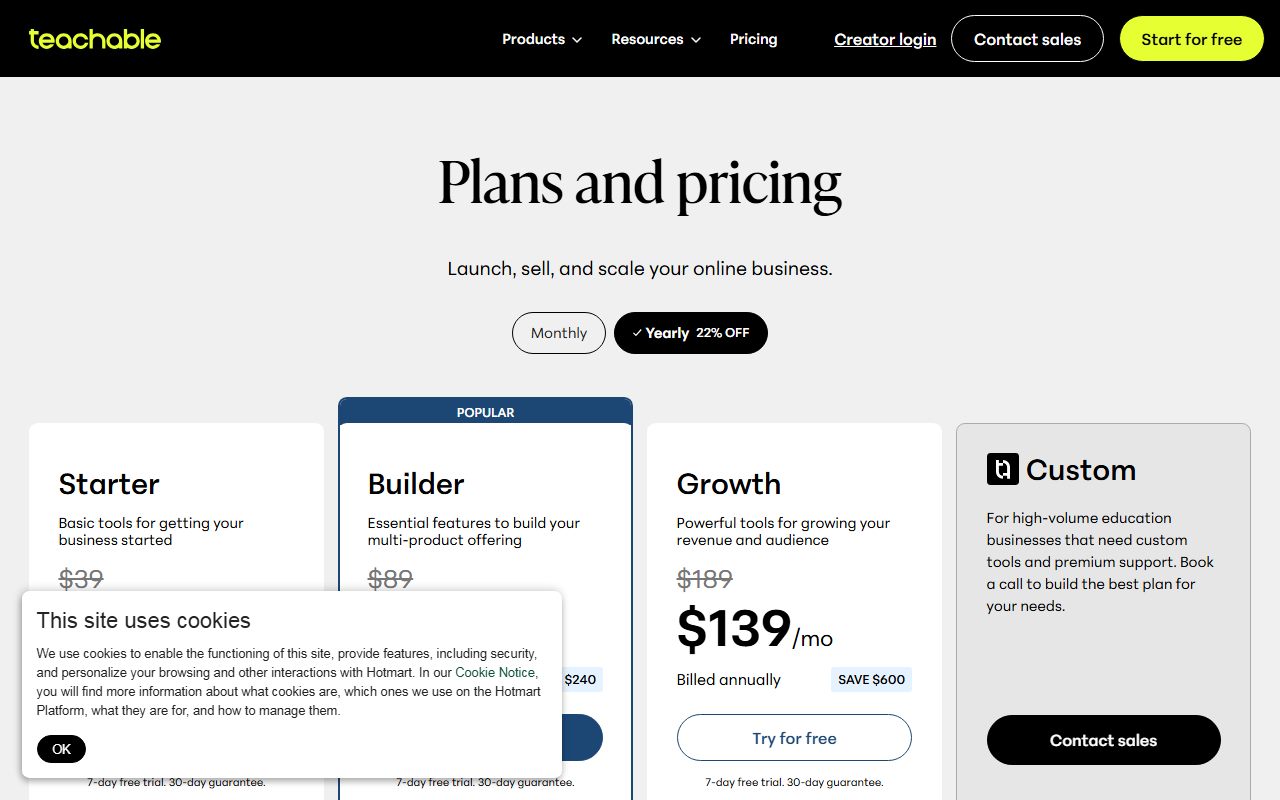
Teachable lists its Starter plan at $39 a month billed monthly, or $29 a month billed annually with a stated saving of $120. The feature row underneath says 5 products and 7.5% transaction fee.
The tier above it, Builder, is listed at $89 monthly or $69 billed annually with a saving of $240. Its feature row says 10 products and 0% transaction fee. Growth is $189 monthly or $139 annually, saving $600, with 50 products.
So the Starter-to-Builder step costs $40 a month on annual billing, or $480 a year by editorial calculation. A 7.5 percent fee reaches $480 at $6,400 of annual sales.
Above roughly $6,400 a year in course sales, the more expensive plan is the cheaper plan. Teachable's own page hints at a similar threshold, asking visitors whether they are selling more than $12k a year.
Podia's version of the same trade
Podia prices its Mover plan at $49 a month billed monthly or $42 a month billed annually, which its page prints as $504 billed annually. The feature row lists 5% fees, up to 50 products and 25 community spaces.
Shaker is listed at $99 monthly or $84 annually, printed as $1,008 billed annually, with 150 products, 100 spaces and no transaction fees. Earthquaker is $179 monthly or $150 annually, printed as $1,800, with unlimited products.
The Mover-to-Shaker step is $42 a month on annual billing, or $504 a year. A 5 percent fee reaches $504 at $10,080 of annual sales, by editorial calculation on the published rates.
Both vendors have set the same trap in the same place. The cheap plan is genuinely cheap only while the shop is quiet, and the crossover is a number you can work out in a minute before signing.
Customers are unlimited, contacts are not
Podia's plan cards list unlimited customers on every tier, so enrolment is not the meter. Email subscribers are: Mover includes 100, Shaker includes 500 and Earthquaker includes 1,000.
The page then publishes a full subscriber ladder as annual totals for the Mover plan. It runs $504 at 100 subscribers, $600 at 500, $672 at 1,000, $768 at 2,500, $936 at 5,000 and $1,176 at 10,000.
At 25,000 subscribers the Mover ladder reads $1,800 billed annually, which is exactly the Earthquaker base price. The list grows to $4,344 at 100,000 subscribers and $12,504 at 500,000.
In other words the cheap plan with a real mailing list costs the same as the top plan with a small one. Contact meters behave this way across the category, as in what contact limits mean in email marketing tools.
Kajabi charges more up front and takes nothing on sales
Kajabi sits at a different price point and states the reason on the page: 0% revenue share. Its Basic plan is listed at $179 a month monthly, or $143 a month annual, billed annually at $1,716 with a stated saving of $432 a year.
Growth is listed at $249 monthly or $199 annual, billed annually at $2,388, saving $600 a year. Pro is $499 monthly or $399 annual, billed annually at $4,788, saving $1,200 a year.
Every one of those annual figures survives the multiplication check. Twelve months at $143, $199 and $399 give $1,716, $2,388 and $4,788 exactly, and each saving matches the gap against the monthly rate.
The included contacts rise steeply: 2,500 on Basic, 25,000 on Growth and 100,000 on Pro, all described as including unlimited email sends. Unlimited products appears only on Pro.
One add-on is worse than an upgrade
Kajabi's FAQ says what happens when contacts run out. It states that contacts come in blocks of 25,000 for $125 a month, at any size, so the add-on price does not change with the plan.
Run that against the plan ladder. Basic at $143 a month includes 2,500 contacts; adding one block takes it to $268 a month for 27,500 contacts, by editorial calculation.
Growth at $199 a month includes 25,000 contacts outright. So the block costs $69 a month more than the upgrade that includes nearly the same allowance, and the upgrade adds features as well.
That is the pattern worth checking on any tool with both tiers and top-ups. The behaviour at the line is covered in what happens when a SaaS usage limit runs out.
Payment processing is a separate stack of percentages
The transaction fee is not the only percentage. Teachable's fee table lists U.S. credit and debit card sales at 2.9% plus 30 cents and international card sales at 3.9% plus 30 cents.
The same table lists U.S. PayPal sales at 3.49% plus 49 cents, international PayPal sales at 4.99% plus 49 cents, and a chargeback fee of $15. An optional BackOffice fee is listed at 2 to 2.8 percent.
On the Starter plan those processing percentages sit on top of the 7.5 percent platform fee. An international PayPal sale on that tier carries roughly 12.5 percent in combined percentage charges, by editorial calculation.
Percentage-of-revenue pricing deserves the same scrutiny as per-unit pricing, and for the same reason set out in per seat, per contact or per credit.
One page we could not read
Thinkific belongs in this comparison and is missing from it. Two fetches of its pricing page on October 31, 2026 returned a bot-verification interstitial rather than a plan list, so no figures from it appear above.
That is a reporting limit, not a claim about the vendor. Its plans and prices are presumably published to a normal browser; they simply were not in the markup we could read.
Six rows to fill before you migrate a course
- The transaction fee percentage on the tier you intend to buy, and the first tier where it reaches zero.
- Your expected annual sales, and the break-even point where the dearer plan becomes cheaper.
- The product cap, counting every course, download, coaching offer and bundle separately.
- The email contact or subscriber allowance, and the published price of the next block.
- Payment processing percentages, which sit on top of any platform fee.
- What the annual commitment actually saves, in money rather than in percent.
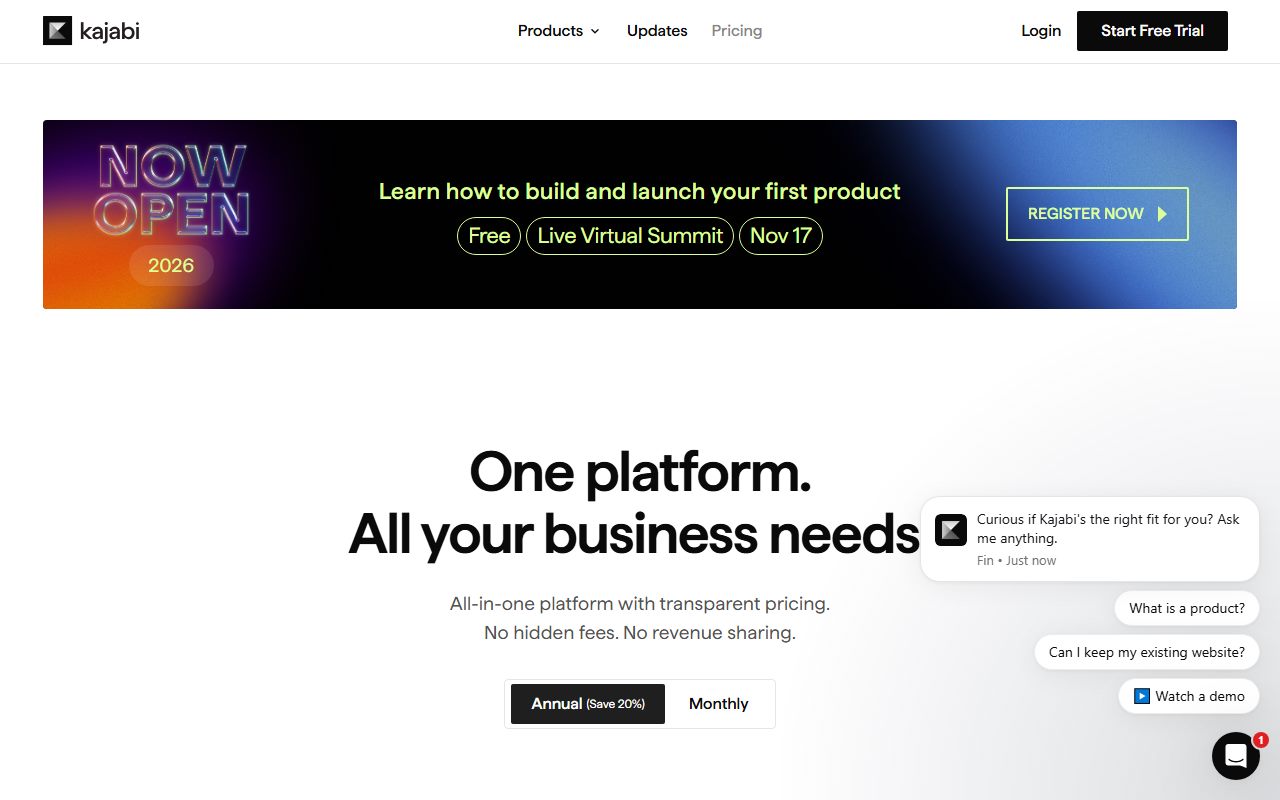
Annual badges in this category describe different things. Kajabi's save 20% holds across all three of its tiers, while Teachable's 22% off badge covers discounts that work out at roughly 25.6, 22.5 and 26.5 percent on Starter, Builder and Growth.
That is why the money matters more than the percentage, as argued in what annual billing discounts actually save. Product caps matter the same way in how knowledge base tools price editors and sites.
Frequently asked questions
Which course platform is cheapest?
It depends on sales volume, not on the plan price. Teachable Starter is $29 a month on annual billing with a 7.5% transaction fee, and Builder is $69 with no fee. The $480 annual gap equals 7.5 percent of $6,400 in sales, by editorial calculation on figures read October 31, 2026.
Do course platforms limit how many students I can have?
Not on the plans read here. Podia lists unlimited customers on every tier. What is capped is products, community spaces, video storage and email subscribers, with Mover including 100 subscribers and Earthquaker including 1,000.
What is a transaction fee on a course platform?
A percentage of each sale taken by the platform, separate from card processing. Teachable lists 7.5% on Starter and 0% on Builder and Growth. Podia lists 5% fees on Mover and no transaction fees on Shaker and Earthquaker.
Is it cheaper to add contacts or to upgrade?
Usually to upgrade. Kajabi states contacts come in blocks of 25,000 for $125 a month at any size. Basic at $143 plus one block is $268 a month, while Growth at $199 already includes 25,000 contacts. Checked October 31, 2026.
How much does Kajabi cost per year?
Its page lists annual billing at $1,716 for Basic, $2,388 for Growth and $4,788 for Pro, which is twelve months at $143, $199 and $399. Monthly billing is listed at $179, $249 and $499 per month.
Does the platform fee replace card processing fees?
No, they stack. Teachable's table lists 2.9% plus 30 cents on U.S. card sales and 4.99% plus 49 cents on international PayPal sales, on top of any plan transaction fee. A chargeback is listed at $15.
Bottom line
Do one sum before you pick a tier: divide the monthly gap between two plans by the transaction fee percentage. That gives the sales figure above which the dearer plan is the cheaper one.
Then count your products honestly. A cap of five is easy to pass if downloads, bundles and a coaching offer each count as a product, and bookings add their own meter as in how booking tools price seats and calendars.
Finally, read the export terms before you upload a year of lessons. Migration is the costly part, which is the subject of what happens to your data after you cancel and of free trial or free plan.
Sources
- Teachable pricing (Starter, Builder and Growth rates, transaction fees, payment processing table) (checked Oct 31, 2026)
- Podia pricing (Mover, Shaker and Earthquaker rates, subscriber ladder, transaction fees) (checked Oct 31, 2026)
- Kajabi pricing (Basic, Growth and Pro rates, included contacts, contact block price) (checked Oct 31, 2026)
- Thinkific pricing (fetched twice, returned a bot-verification page rather than plan prices) (checked Oct 31, 2026)