How Business Email Plans Price Mailboxes
A business email plan is priced per mailbox, and what you get per mailbox is storage counted two incompatible ways. Here is what Google Workspace, Microsoft 365, Zoho Mail and Fastmail publish, read on October 31, 2026.
This article is a documentation review: it is based on the vendors' own published pages, checked on the date shown. We may earn a commission from some links; it never affects what we recommend.

A business email plan is priced per mailbox, but what you buy per mailbox is storage, and the two largest vendors now count it differently. One pools it across the whole organisation. The other assigns a fixed allowance to each person.
This guide reads four published pricing pages - Google Workspace, Microsoft 365, Zoho Mail and Fastmail - and records what a mailbox costs, what storage arrives with it, and which of the printed figures expires.
Every number below was read from the vendors' own pages on October 31, 2026. Where a page printed two prices for the same plan, both appear here.
The headline price is a seat, and the seat count is capped
Google Workspace's pricing page states that Business Starter, Business Standard, and Business Plus plans can be purchased for a maximum of 300 users, and that there is no minimum or maximum user limit for Enterprise plans.
Microsoft's comparison page sets the same ceiling. It states that business base plans charged per user are designed for organizations with up to 300 users, and directs larger organisations to the enterprise plans instead.
That cap matters more than it looks. Both vendors are saying the small-business price list has an exit, and the exit is a separate negotiation. Floors work the other way, as in what a minimum seat count does to small teams.
Google prints two prices and one of them expires
Google Workspace lists Business Starter at $7.00 per user per month and Business Standard at $14.00, with the note that price is per user/month and does not include tax. Business Plus is listed at $22 per user per month.
Both lower tiers carry a discount badge. Starter shows 50% off for 12 months, limited to 20 users, printed as $3.50. Standard shows 40% off for 12 months, also limited to 20 users, printed as $8.40.
The arithmetic settles which figure is the list price. Half of $7.00 is $3.50, and 40 percent off $14.00 is $8.40, by editorial calculation. The discount is the smaller number in each pair, and it runs out.
The page even carries the expiry. Against both discounted rows it shows Nov 14, 2027 - Onwards, the point from which the undiscounted rate applies. Budget year two at $7.00 and $14.00, not at the sticker you signed on.
Storage is pooled at Google and assigned at Microsoft
Google's footnote is explicit. It states that Business Starter includes 30 GB pooled storage per user, Business Standard includes 2 TB, and Business Plus and Enterprise Plus include 5 TB, shared across the organisation.
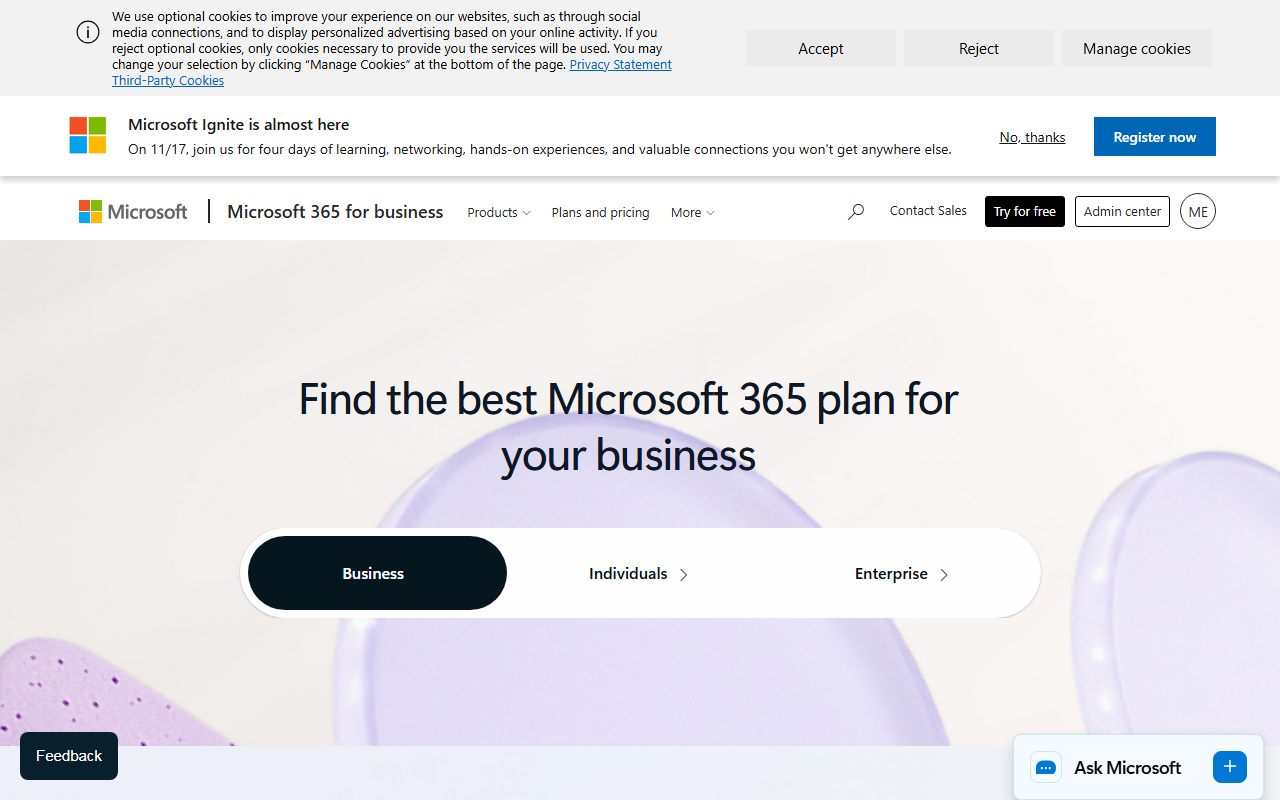
Microsoft assigns storage instead. Its comparison table lists mailbox storage as 100 GB primary and 50 GB archive storage per user, and adds 1 TB of cloud storage per user. Those are personal allowances, not a shared pot.
The difference decides who runs out first. A pooled 30 GB per user means one heavy mailbox can consume a colleague's share. A per-user cap means it cannot. Storage meters read the same way in how to read a cloud backup pricing page.
Microsoft now sells Copilot inside the plan card
The Microsoft page prices Business Basic at $7.00 per user per month paid yearly. Above it, the cards on display are Business Standard with Copilot at $23.50 and Business Premium with Copilot at $32.00, both paid yearly.
A standalone AI line appears too. The page lists Microsoft 365 Copilot Business as an add-on at originally starting from $21.00, now starting from $18.00 per user per month paid yearly.
AI folded into a tier you were going to buy anyway is harder to price than an add-on you can decline. That problem is worked through in what AI costs inside a plan you already pay for.
The no-Teams variants put a price on chat
Microsoft lists each tier twice, with and without Teams. Business Standard with Copilot (no Teams) is $20.30 and Business Premium with Copilot (no Teams) is $28.80, against $23.50 and $32.00 for the versions that include it.
Both of those gaps are $3.20 per user per month by editorial calculation. Business Basic is $7.00 and Business Basic (no Teams) is $5.40, a gap of $1.60, so chat is not priced identically at every tier.
Meeting capacity shows up on the Google cards instead, which list 150 participants and 500 participants against the higher tiers. Participant ceilings are the main variable in how to read a video conferencing pricing page.
Zoho sells storage tiers, and two of them are annual only
Zoho Mail lists Mail Lite 5GB at US$1 per user per month billed annually and Mail Lite 10GB at US$1.25. The only difference named in the plan title is the mailbox size. Mail Premium is listed at US$4 billed annually.
Two of those rows have no monthly option at all. Against Mail Lite and Mail Premium the monthly column reads Yearly subscriptions only, so the annual commitment there is not a discount. It is the only way to buy.
The Workplace bundles do offer both. Workplace Standard is listed at US$3 per user per month billed annually or US$4 billed monthly, and Workplace Professional at US$6 billed annually or US$7 billed monthly.
Zoho's own page sets out what that buys. In Workplace Standard each user gets 30 GB of email storage and 10 GB shared WorkDrive. In Workplace Professional each user gets 100 GB of email storage and 100 GB shared WorkDrive.
Attachment limits differ as well. The comparison grid lists up to 250 MB on Mail Lite and up to 1 GB on Mail Premium and Workplace Professional. That is a daily working constraint rather than a marketing line.
Fastmail publishes the annual total, which is rarer than it should be
Fastmail lists Basic at US$4 per user per month paid monthly, or US$3 per user per month yearly, printed as US$36 for 12 months. Standard is US$6 monthly or US$5 yearly, printed as US$60 for 12 months.
Professional is US$10 monthly or US$9 yearly, printed as US$108 for 12 months. All three annual totals survive the multiplication check: $3, $5 and $9 times twelve give $36, $60 and $108 exactly.
Its storage lines name the split rather than one headline. Standard is listed as 60 GB total storage per user, which the page breaks down as 50 GB for mail, calendar and contacts, and 10 GB for file storage.
Basic is listed at 6 GB total per user and Professional at 150 GB. The page adds that if you need more, you can purchase up to 300 GB per user, which makes storage an add-on rather than a reason to change tier.
Five rows to fill before you move a domain
- The list price and the introductory price, with the date the introductory one ends.
- Whether storage is pooled across the organisation or assigned per user, and the figure for each.
- Whether the tier you actually want can be bought monthly, or only on an annual commitment.
- The seat ceiling, and what happens to the price list once you pass it.
- Which components are priced separately - chat, AI, extra storage - and at which tiers.
Then ask one question in writing: what the renewal costs once the introductory period ends. Google prints that date. Most vendors do not, which is why the annual arithmetic is worth doing by hand, as in what annual billing discounts actually save.
Mailbox counts also move more than seat counts on other tools, because leavers keep their archive. Mid-cycle changes are covered in how mid-term seat changes are prorated, and freelance mailboxes in how per-user pricing works with contractors.
Frequently asked questions
Is Google Workspace or Microsoft 365 cheaper for a small team?
At the entry tier they match. Google Workspace lists Business Starter at $7.00 per user per month and Microsoft lists Business Basic at $7.00 per user per month paid yearly, both checked October 31, 2026. The storage differs: 30 GB pooled against 100 GB primary plus 50 GB archive per user.
What does pooled storage mean on a business email plan?
It means the allowance is multiplied by headcount and then shared. Google's footnote states that Business Starter includes 30 GB pooled storage per user, shared across the organisation, so a single heavy mailbox can draw down what colleagues are not using.
Why does Microsoft list the same plan twice?
Because it sells a version without Teams. Business Standard with Copilot is $23.50 and the no-Teams version is $20.30, while Business Premium with Copilot is $32.00 against $28.80. Both gaps are $3.20 per user per month by editorial calculation, checked October 31, 2026.
Can you buy Zoho Mail monthly?
Not on every plan. Against Mail Lite and Mail Premium, the monthly column on Zoho's pricing page reads Yearly subscriptions only, as of October 31, 2026. The Workplace bundles do publish both, at US$3 or US$4 for Standard and US$6 or US$7 for Professional.
Does the introductory discount apply to every seat?
No. Google's badges state 50% off for 12 months limited to 20 users on Business Starter and 40% off for 12 months limited to 20 users on Business Standard. A team of thirty pays the full $7.00 or $14.00 on the seats above twenty.
How much storage can you add without changing tier?
On Fastmail the page states that if you need more, you can purchase up to 300 GB per user, on top of the 6 GB, 60 GB and 150 GB totals listed for Basic, Standard and Professional. Checked October 31, 2026.
Bottom line
Price the second year, not the first. Google is unusually honest in printing the date its discount ends, and that date is the number most worth copying into a spreadsheet before you commit a domain to anyone.
Then price storage the way the vendor counts it. Pooled and per-user allowances are not comparable, and a mailbox that fills up is an operational problem long before it becomes a billing one.
Finally, check the exit before the entrance. Archives are the part of an email migration that hurts, which is the territory of what happens to your data after you cancel and of free trial or free plan.
Sources
- Google Workspace pricing (introductory discounts, pooled storage footnote, 300-user cap) (checked Oct 31, 2026)
- Microsoft 365 business plan comparison (plan prices, no-Teams variants, mailbox storage limits) (checked Oct 31, 2026)
- Zoho Mail pricing (Mail Lite, Mail Premium and Workplace tiers, attachment limits) (checked Oct 31, 2026)
- Fastmail pricing (monthly and yearly rates, annual totals, storage splits) (checked Oct 31, 2026)